Introduction
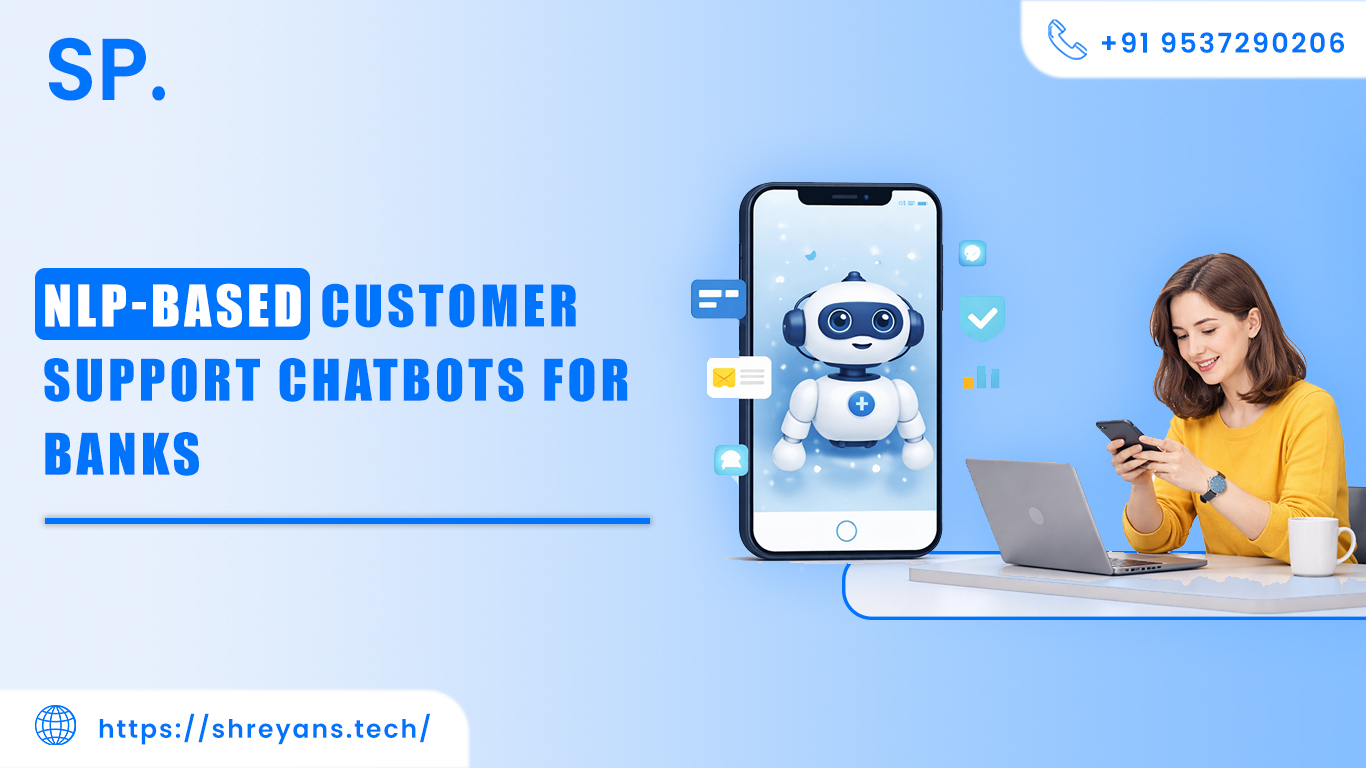
Imagine calling your bank at 2 AM because you noticed a suspicious transaction and getting an instant, intelligent response without waiting on hold for 45 minutes. That's no longer a dream. Thanks to Natural Language Processing (NLP), banks around the world are deploying smart chatbots that understand what you say, interpret what you mean, and respond in a way that feels genuinely helpful.
NLP-based chatbots are rapidly becoming one of the most transformative technologies in the banking sector. They don't just answer pre-programmed questions, they understand natural human language, learn from conversations, and resolve complex queries without ever needing a human agent.
In this guide, we'll break down exactly what NLP chatbots are, how banks are using them, what the real-world benefits and challenges look like, and where this technology is heading in the future. Whether you're a banking professional, a fintech enthusiast, or simply a curious reader this blog is for you.
What Is an NLP-Based Chatbot?
A Natural Language Processing (NLP) chatbot is an AI-powered software program that understands, interprets, and responds to human language whether typed or spoken in a conversational manner.
Unlike older rule-based chatbots that could only respond to rigid, pre-set commands (e.g., "Press 1 for balance"), NLP chatbots can:
-
Understand sentences written in everyday language
-
Detect the intent behind a message (e.g., "I think someone stole my card" = report fraud)
-
Identify key entities in the sentence (card number, account type, date)
-
Maintain context across a multi-turn conversation
-
Learn and improve with every interaction
The core technologies powering them include machine learning (ML), deep learning, sentiment analysis, and transformer-based language models like BERT and GPT.
Why Are Banks Investing Heavily in NLP Chatbots?
Banking is one of the highest-volume customer service industries in the world. Millions of people contact their banks every day for routine queries — checking account balances, transferring money, reporting lost cards, or understanding fees. This creates enormous pressure on customer service teams.
Here's why NLP chatbots have become a strategic priority for banks:
1. Massive Volume of Repetitive Queries
A large percentage of customer support tickets in banking are repetitive. Questions like "What is my account balance?" or "How do I reset my PIN?" don't require human expertise they just need quick, accurate answers. Chatbots handle these effortlessly at scale.
2. 24/7 Availability
Banks operate within business hours, but customer problems don't. NLP chatbots provide round-the-clock support — a critical advantage in today's always-on digital world.
3. Cost Efficiency
Hiring and training human agents is expensive. A well-deployed chatbot can handle thousands of concurrent conversations at a fraction of the cost, significantly reducing operational expenses.
4. Rising Customer Expectations
Today's banking customers — especially millennials and Gen Z — expect instant digital responses. They prefer messaging over phone calls and want their issues resolved in seconds, not minutes.
5. Competitive Pressure
With neobanks and fintech startups offering sleek, AI-powered interfaces, traditional banks must modernize their customer experience to stay competitive.
Real-World Applications of NLP Chatbots in Banking
Banks aren't just experimenting they're deploying chatbots at scale across a range of critical functions. Here are the most prominent real-world applications:
1. Account Balance and Transaction Inquiries
This is the most common use case. Customers simply ask, "What's my current balance?" or "Show me transactions from last week," and the chatbot instantly fetches and displays the information in a conversational format.
2. Fraud Detection and Reporting
NLP chatbots can detect unusual language patterns that suggest a customer is reporting suspicious activity. They can immediately flag the transaction, block the card if necessary, and initiate a fraud investigation — all within the chat window.
Example: Bank of America's virtual assistant Erica helps customers identify potential fraud, track spending, and even receive proactive alerts about unusual account activity.
3. Loan and Credit Card Applications
Chatbots guide customers through complex application processes — asking for required documents, explaining eligibility criteria, and pre-qualifying customers — all through natural conversation.
4. Payment Processing and Fund Transfers
Customers can initiate fund transfers by simply typing "Send ₹5,000 to Rahul" or "Pay my credit card bill." The chatbot processes the intent, confirms the details, and executes the transaction securely.
5. Customer Onboarding
For new customers, chatbots can walk through the entire account opening process — collecting KYC details, explaining product options, answering questions — reducing onboarding time from days to minutes.
6. Personalized Financial Advice
Advanced NLP systems analyze a customer's spending patterns and proactively offer personalized suggestions — like "You've spent 30% more on dining this month. Would you like to set a spending limit?"
Example: Capital One's Eno chatbot monitors transactions, sends alerts, and even helps customers manage subscriptions they may have forgotten about.
7. Complaint Resolution
Instead of putting customers on hold, chatbots can acknowledge complaints, log tickets, provide resolution timelines, and escalate to human agents when needed — all seamlessly.
8. Regulatory and Compliance Support
Banks use internal NLP chatbots to help employees quickly access compliance documents, regulatory guidelines, and internal policies — reducing the time spent on manual searches.
Key Technologies Behind Banking NLP Chatbots
Understanding what makes these chatbots work helps explain why they're so powerful:
Intent Recognition — Identifies what the user wants to do (e.g., check balance, transfer money, report an issue).
Entity Extraction — Pulls out important pieces of information from a sentence (e.g., account number, amount, date).
Sentiment Analysis — Detects if a customer is frustrated, confused, or satisfied — triggering appropriate responses or escalations.
Dialogue Management — Keeps track of what was said earlier in the conversation to maintain context across multiple messages.
Machine Learning Models — Learn from millions of previous interactions to continuously improve accuracy and response quality.
API Integration — Connects the chatbot to core banking systems, CRM software, payment gateways, and fraud detection tools in real time.
Major Benefits of NLP Chatbots for Banks
For Banks:
-
Reduced operational costs — One chatbot can do the work of hundreds of agents for routine queries
-
Higher scalability — Handle seasonal spikes (like tax season or year-end) without hiring extra staff
-
Faster resolution rates — Average handle time drops significantly
-
Better data insights — Every conversation generates valuable data about customer needs and pain points
-
Reduced human error — Automated processes minimize mistakes in data entry and transactions
For Customers:
-
Instant responses — No more waiting in queue
-
24/7 availability — Help is always just a message away
-
Consistent experience — No variation in quality based on which agent you reach
-
Multilingual support — Modern NLP chatbots can understand and respond in multiple languages
-
Proactive notifications — Alerts about due payments, unusual spending, or account changes
Challenges and Limitations
No technology is without its limitations. Banks deploying NLP chatbots must navigate several important challenges:
1. Understanding Complex or Ambiguous Queries
Human language is often vague, emotional, or context-dependent. "I'm having trouble with my account" could mean anything — and even advanced NLP systems sometimes misinterpret intent.
2. Data Privacy and Security
Banking involves highly sensitive personal and financial data. Any chatbot system must comply with regulations like GDPR, PCI-DSS, RBI guidelines (in India), and other regional data protection laws. A single breach can be catastrophic.
3. Integration with Legacy Systems
Many traditional banks run on outdated core banking infrastructure. Integrating modern AI chatbots with these legacy systems is technically complex and expensive.
4. Customer Trust and Acceptance
Some customers — particularly older demographics — are reluctant to share financial concerns with a bot. Building trust in AI-powered systems remains an ongoing challenge.
5. Handling Emotional Conversations
When a customer has lost their life savings to fraud or is deeply stressed about a financial crisis, a chatbot's tone and empathy must be carefully calibrated. Getting this wrong can cause serious reputational damage.
6. Continuous Maintenance
NLP models require regular retraining as language evolves, new products launch, and regulatory requirements change. This demands ongoing investment in AI expertise.
Leading Examples of NLP Chatbots in Banking
|
Bank |
Chatbot Name |
Key Features |
|
Bank of America |
Erica |
Spending insights, fraud alerts, bill reminders |
|
Capital One |
Eno |
Transaction monitoring, subscription tracking |
|
HDFC Bank (India) |
Eva |
Account queries, loan info, branch locator |
|
ICICI Bank (India) |
iPal |
Account management, fund transfer assistance |
|
Wells Fargo |
Fargo |
Personalized financial insights via Google Assistant |
|
DBS Bank (Singapore) |
Digibank AI |
Full conversational banking experience |
The Future of NLP Chatbots in Banking
The evolution of NLP chatbots in banking is just getting started. Here's where the technology is heading:
Voice-First Banking — Chatbots are moving beyond text to fully conversational voice interfaces, integrated with smart speakers and mobile assistants.
Hyper-Personalization — Future chatbots will combine NLP with real-time behavioral analytics to offer advice that's uniquely tailored to each individual customer.
Emotionally Intelligent AI — Research in affective computing will give chatbots the ability to detect and respond to emotional cues more naturally and empathetically.
Proactive Financial Coaching — Instead of just answering questions, chatbots will proactively reach out to customers with relevant alerts, budget suggestions, and savings opportunities.
Integration with Open Banking — As open banking APIs expand, chatbots will access a wider financial picture — helping customers manage accounts across multiple banks from a single interface.
Multimodal Interactions — Combining text, voice, images (like photos of receipts or cheques), and video for richer support experiences.
Frequently Asked Questions (FAQs)
Q1. What is an NLP chatbot in banking?
Ans: An NLP (Natural Language Processing) chatbot in banking is an AI-powered virtual assistant that can understand and respond to customer queries in natural, everyday language. Unlike older automated systems, NLP chatbots understand the intent and context behind a message — not just keywords.
Q2. How do banking chatbots keep my data safe?
Ans: Reputable banking chatbots are built with enterprise-grade security — including end-to-end encryption, multi-factor authentication, and strict compliance with data protection regulations such as GDPR, PCI-DSS, and regional banking laws. No sensitive data is stored within the chatbot itself; it communicates with secure banking APIs.
Q3. Can a chatbot fully replace human bank agents?
Ans: No — at least not yet. NLP chatbots excel at handling high-volume, routine queries efficiently and at scale. However, complex issues, emotional situations, or high-stakes decisions still benefit greatly from human empathy and judgment. The best model is a hybrid: chatbots handle routine tasks, humans handle exceptions.
Q4. Which banks use NLP chatbots in India?
Ans: Several major Indian banks have deployed NLP chatbots — HDFC Bank's Eva, ICICI Bank's iPal, and SBI's chatbot are prominent examples. Many private and digital banks are also rapidly expanding their AI-powered support capabilities.
Q5. How accurate are banking NLP chatbots?
Ans: Accuracy depends on the quality of training data, the sophistication of the model, and the complexity of queries. Leading banking chatbots report intent recognition accuracy above 85–90% for common queries. Accuracy improves continuously as the model learns from more conversations.
Q6. What happens when a chatbot can't answer my question?
Ans: Well-designed banking chatbots have a seamless escalation protocol. When the chatbot cannot resolve a query — due to complexity, ambiguity, or emotional sensitivity — it smoothly hands off the conversation to a live human agent, along with a full summary of the conversation so the customer doesn't have to repeat themselves.
Q7. Are NLP chatbots expensive for banks to build?
Ans: Initial development costs can be significant, but the return on investment is typically very strong. Banks report saving millions annually in support costs after deploying chatbots. Many banks now use third-party NLP platforms (like IBM Watson, Google Dialogflow, or Microsoft Azure Bot Service) to reduce development time and cost.
Q8. What languages can banking chatbots support?
Ans: Modern NLP chatbots can support dozens of languages. Indian banks, for example, deploy chatbots capable of handling queries in Hindi, Tamil, Telugu, Bengali, and other regional languages making banking services more accessible to a wider population.
Conclusion
NLP-based customer support chatbots are no longer a futuristic concept, they are a present-day reality transforming how banks engage with their customers. From resolving a simple balance inquiry at midnight to detecting fraud in real time, these intelligent systems are making banking faster, smarter, and more accessible than ever before.
For banks, the benefits are clear: dramatically lower operational costs, higher efficiency, and the ability to scale customer support without scaling headcount. For customers, the payoff is equally compelling: instant answers, personalized insights, and 24/7 availability without the frustration of long wait times.
That said, deploying NLP chatbots successfully requires more than just buying an AI platform. Banks must invest in quality training data, robust security architecture, thoughtful conversation design, and continuous improvement cycles. The banks that do this well will not just reduce costs they will build stronger, more loyal customer relationships in the process.
As NLP technology continues to advance with improved language understanding, emotional intelligence, and voice capabilities the line between talking to a bot and talking to a knowledgeable human advisor will continue to blur. The future of banking customer service is conversational, intelligent, and always-on.



Shreyans Padmani
Shreyans Padmani has 5+ years of experience leading innovative software solutions, specializing in AI, LLMs, RAG, and strategic application development. He transforms emerging technologies into scalable, high-performance systems, combining strong technical expertise with business-focused execution to deliver impactful digital solutions.